Aerospace History: Hong Kong
1. The First Flight
Aviation really began in Hong Kong with the balloon flights of the intrepid Baldwin brothers in 1891, but it was not until thirty years later that the first powered flight was made. The honour of making that first powered flight went to a former cycling champion from Belgium, Charles Van den Born, who arrived in Hong Kong in February 1911 with three Henry Farman biplanes that he had used already for flying exhibitions in Bangkok and Saigon.
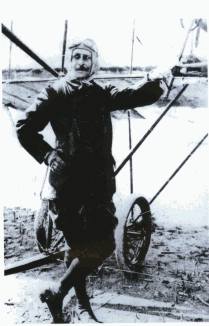
Initially van den Born was unable to obtain the necessary permission to fly his Farman from Happy Valley. However, with the help of local businessmen, he eventually received permission to fly from the beach at Sha Tin. A three day flying extravaganza was duly advertised to begin, weather permitting, on the 18th of March. On the appointed day, the weather appeared fine and a special excursion train on the newly opened Kowloon-Canton Railway was provided to take spectators to the site. Departure of the train was delayed due to the late arrival of the Governor, Sir Frederick Lugard. By the time the train arrived at Sha Tin, the wind had picked up making flying conditions hazardous. Because Van den Born's flimsy biplane could not be flown in strong winds, most of the disappointed spectators went home. After they had gone, however, the winds again subsided, allowing Van den Born to take to the air for the first time. So it was that the first flight in Hong Kong was seen only by a few of the remaining loyal spectators and the local farmers and fishermen of Sha Tin.
2. Early Aircraft
The first flight in Hong Kong in March of 1911 was soon followed by others. Within a few months, a Bleriot monoplane, of the same type that made the first successful crossing of the English Channel in 1908, was being flown in Sha Tin.
In 1923 a Canadian Chinese businessman, Lim On brought a Curtiss JN-4C Jenny to Hong Kong, but crashed it while flying from Happy Valley. The wreck was bought and restored by an American, Harry Abbott. After some spectacular stunt flights over Hong Kong, Abbott crashed this plane, but undaunted, bought another JN-4D and a Curtiss Oriole and started a school of aviation at Kai Tak in 1925. This closed down the same year, but was followed in 1927 by the Hong Kong Flying Club, operating two Avro Avians. This ceased business in 1932, but its place was quickly taken by the Far East Flying Training School, operating one Avro Avian and three Avro Cadets.
Aviation pioneers from around the world soon began to call at Hong Kong. The Americans, Brock and Schlee, flying round the world in the "Pride of Detroit”, a Stinson SM-1f Detroiter, landed here in 1927. They were followed by F. R. Loring in a Comper Swift flying from Madrid to Manila and Fraulein von Erzdorf flying from Japan to Surabaya. Individual flights soon gave way to regular commercial flights by flying boats and land planes, but the pioneering work of these brave pilots gave inspiration to many local people, both Chinese and expatriate, to master the art of flying for themselves.
3. Early Commercial Aircraft – 1936 to 1960
The first commercial passenger flight into Kai Tak Airport was made by a De Havilland D.H. 86 Express Airliner named "Dorado" on 24 March 1936 carrying one passenger. The Express was a biplane, with four engines and a fully enclosed cabin. Soon large monoplanes such as the Junkers JU-52s and Douglas DC-2s, were making regular flights into Hong Kong from Shanghai, Guangzhou and other parts of China and South East Asia. Growth in commercial aviation continued until the outbreak of World War II and the fall of Hong Kong in December 1941.
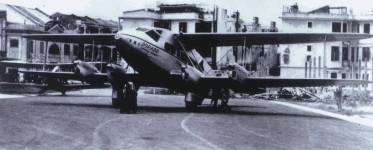
After the war commercial flights to Kai Tak resumed in September 1945 with the arrival of a DC-3 of the China National Aviation Company. Many more DC-3s followed, the most famous being Cathay Pacific's first aeroplane, Betsy, which can now be seen on permanent display at the Hong Kong Science Museum. To these were added Curtiss C-46 Commando freighters, the Douglas DC-4, which could fly from Hong Kong to Europe in only three days, the Canadair BOAC Argonauts and Lockheed Constellations. The most powerful propeller driven passenger aircraft to visit regularly were the Bristol Britannias of BOAC.
Even as the Britannias and Lockheed Electra turboprops were coming into service in the late 1950�s, however, new generations of commercial aircraft were beginning to roll off the production lines – the jets. So successful were they that within a decade the old propeller driven airliners had become a rare sight at Kai Tak.
4. Military Aircraft
Although the Hong Kong Chamber of Commerce raised money in 1915 for the purchase of a Vickers Gunbus aircraft for the Royal Flying Corps fighting in France, the first military aircraft did not come to Hong Kong until 1924. In that year the seaplane carrier HMS Pegasus arrived with four Fairey IIID seaplanes of the Fleet Air Arm to undertake the first aerial survey and mapping in the Far East. These were followed by a squadron of Fairey Flycatchers that equipped the first Royal Air Force detachment to be stationed at Kai Tak in 1927.
In 1935, the RAF flight was equipped with three Hawker Horsleys and two De Havilland Tiger Moths. The Horsleys were replaced in 1937 by Vickers Wildebeests. Three Walrus amphibian aircraft and two Swordfish torpedo planes of the Fleet Air Arm Reserve were also based here. These obsolescent aircraft proved to be no match for the nimble Japanese Zero fighters that attacked Hong Kong in 1941.
During the war, American B-24 Liberator and B-25 Mitchell bombers made several raids on Hong Kong, to be met by Japanese Zeros stationed at Kai Tak. At the end of hostilities in 1945, RAF Spitfire fighters soon arrived. These operated until 1951, accompanied by Fleet Air Arm Corsairs and, for a short while, Beaufighters. As newer types became available there followed a succession of Hornets, Vampires and Hawker Hunters, all of which were withdrawn by 1962. Until 1968, the only military aircraft in Hong Kong were visitors, mostly transport aircraft, but in that year No. 28 Squadron RAF was reformed at Kai Tak, equipped with Westland Whirlwind helicopters. 660 Squadron Army Air Corps was also based here with Westland Scout helicopters. The Scouts remained until 1994, while the Whirlwinds were replaced in 1975 with the familiar Wessex helicopters that operate today around Hong Kong from their base at RAF Shek Kong.
5. The Far East Flying Training School
The aviation industry in the West Pacific Rim region is expanding rapidly and this will require the training of pilots, aircrew, engineers, cabin staff, air traffic controllers and many other technicians and administrators required to ensure that the industry is run safely and efficiently. This situation is really nothing new, however, for in the 1920s and 1930s there also was a rapid growth in aviation for civilian and military use in the region. The resultant training needs were recognised in Hong Kong by Vaughan Fowler who had the vision and determination to set up the first aviation academy in Asia, known as the Far East Flying Training School (FEFTS).
Vaughan Fowler started his career in aviation in the Royal Air Force, reaching the rank of Wing Commander. His vision of setting up an aviation academy was shared by Air Commodore A. V. Harvey, CBE, and Mr W. F. Dudman and Mr. Murray. Backing was given by the Far East Aviation Company and the new school was set up at Kai Tak airport in 1934.
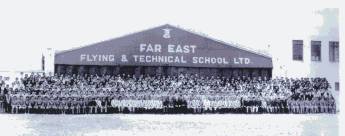
From the very beginning, the school became very popular, drawing students from many countries in Asia. The courses offered covered the training of civil pilots, engineers and wireless operators. However, the invasion of Hong Kong by the Japanese in December 1941 resulted in closure of the school and its subsequent demolition.
Post war, the FEFTS made a rapid recovery under the management of Mr W. F. Dudman, Mr Hall and Mr H. K. Watt. In 1951, the school was absorbed into the Wheelock Marden Group of companies, thus providing it with a secure financial foundation. Shortly thereafter, the school had to be shifted to new premises at the north-west corner of the airport, this being the site currently occupied by the present Hong Kong Aviation Club. However, in 1962, typhoon Wanda caused extensive damage and the loss of the school�s aircraft. This resulted in pilot training activities having to be abandoned and, subsequently, that function was taken over by the Aero Club of Hong Kong. The school then changed its name to the Far East Flying and Technical School.
In its heyday during the post-war years, the FEFTS had an enrolment of some 800 students and a staff of nearly 50 instructors providing training in a range of aeronautical subjects, including gas-turbines and electronics. The majority of local students were subsequently employed by the Hong Kong Aircraft Engineering Company (HAECO) and other prominent companies worldwide.
In later years, the school suffered from the competition of such institutions as the Hong Kong Polytechnic and continued operation no longer remained viable. It was sold to the Aviation Club in 1983 after graduating more than 6,000 students. However, excluding the war years, the school gave 35 years of, excellent service in the training of pilots and technicians who later used their hard won skills in building up a vigorous aviation industry in Hong Kong.
6. Helicopters
Helicopters are ideally suited to Hong Kong's environment and have served here in many roles – invaluable and proven performers. The first "rotary wing" machine in Hong Kong, although not a true helicopter, was the Cierva C-30A Autogyro, brought here in 1934. It was a spectacular and revolutionary machine which could take off steeply after a 30 yard run, maintain controlled flight at speeds between 25 and 100 miles per hour, hover briefly and generally go where no conventional aircraft could. Unfortunately, the autogyro was written-off in an accident in 1936 when a sudden gust of wind overturned the machine on the ground.
Helicopters have been used by the Auxiliary Air Force, now Government Flying Service, since 1958 to provide casualty evacuation, search and rescue, emergency response, fire fighting and even a Flying Doctor service. Royal Air Force Whirlwind helicopters were introduced to Hong Kong in 1967, employed on internal security duties, and the familiar Wessex will continue to fly with the RAF here until mid 1997.
Private operators have provided a variety of charter and scheduled helicopter services including sightseeing, air taxi, construction and aerial photography. The Aerospatiale Lamas of Heliservices (Hong Kong) Ltd. were initially used to assist with the building of overhead power transmission towers on the rugged and inaccessible slopes of the New Territories in 1978. The Heliservices fleet now includes two Lamas and one Aerospatiale AS-355N Twin Squirrel which perform a wide variety of photographic, survey and charter work. The Twin Squirrel helicopter is now available for charter taking off and landing on the rooftop helipad of the famous Peninsula hotel in Kowloon. A regular passenger service to Macau was started in 1985 by the sleek Bell 222s of East Asian Airways and passenger charters are now a popular means of sightseeing and travel to nearby destinations.
The first privately owned helicopter in Hong Kong was a Hughes 300C, purchased in 1974 by Mr. Michael Kadoorie. Mr. Kadoorie, an accomplished pilot, has owned a number of helicopters and will soon take delivery of a new MD-500N "NOTAR", the latest "no tail rotor" private helicopter. Several privately owned machines are now seen regularly in the skies of Hong Kong flying for both business and pleasure.
7. Seaplanes
Water flying, in its various forms, has attracted the aviation-minded of Hong Kong for almost as long as they have been flying. Hong Kong with its many islands, miles of coastline and sheltered waters is potentially ideal for seaplanes but there are problems as well, due to the geographical location and sometimes violent weather.
Some of the more interesting seaplanes in Hong Kong's past have included the commercial aircraft of Charles de Ricou's unsuccessful Macau Aerial Transport Company in 1920, and the first military seaplanes which conducted aerial surveys of Hong Kong in 1924. Seaplanes were more common in those early years because they didn't require anything more than an open stretch of water for a runway. The developed airports we enjoy today were still a long way in the future.
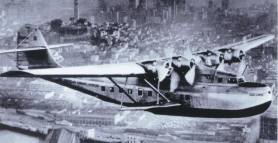
In addition to the fabulous, pioneering transpacific Clippers, long range flying boats and the post war amphibian Catalinas and Piaggio of Cathay Pacific and MATCO, a number of private seaplanes have also been registered in Hong Kong. These have included the Saunders Roe Cutty Sark and Vickers Armstrong Sea Otter of the Far East Flying Training School in the 1930s, the versatile 1948 Republic RC-3 Seabee amphibian owned by local businessman K. B. Lee and a Stinson L-5 on floats, the "Marco Polo", whose owners hoped to fly commercially between Hong Kong and Macau in 1949, On the military side, the RAF flew Fairy III float planes and Supermarine Walrus amphibians for reconnaissance duties here from 1935 to 1941 and post-war a squadron of RAF Sunderland flying boats was based at Kai Tak.
There are no seaplanes flying in Hong Kong at present. Perhaps in the future with a more open China to the north, abounding with suitable lakes and rivers for seaplane operations, the practical, versatile and exciting seaplane will make a comeback to the waters and skies of Hong Kong.
8. Flying Boats
Before airports were widespread, flying boats offered a good alternative to land planes, being able to land anywhere there was fairly calm water. Hong Kong harbour offered the perfect landing ground for these planes. As early as 1924, the RAF was operating seaplanes here, while in 1928, four Southampton flying boats of the Far East Flight, a record setting long-range flight from England to Australia, visited Hong Kong.
It was the American flying boats, however, operated by Pan American Airways that established the first international cargo and passenger service into Hong Kong in 1937. Pan Am built up a network of landing areas on islands across the Pacific, in order to establish scheduled passenger and air mail services from California to Manila and Hong Kong. Four engined Sikorsky, Martin and Boeing flying boats were developed to fly on this route. The Martin M-130 and Boeing B-314 bore the brunt of the pioneering transpacific flights until the outbreak of World War II. The venerable Sikorsky S-42B "Hong Kong Clipper" was utilised for the Manila to Hong Kong segment of the route. Affectionately known as "Myrtle" to her crew, the S-42B was destroyed during the Japanese attack on Kai Tak in December 1941.
After World War II, the Pan Am flying boat service was not resumed, but the British Overseas Airways Corporation started a commercial service in 1947, using civilianised Sunderland flying boats and the similar but more refined Sandringham. Flying out to Hong Kong via Augusta, Cairo, Bahrain, Karachi, Calcutta, Rangoon and Bangkok, these aircraft linked England to the Far East. But the days of the flying boat were numbered as airports, Kai Tak among them, were developed to take the new generation of the fast, long range, land based aircraft. 1951 saw the last international flight by a flying boat into Hong Kong.
Local flying boat services were provided by Cathay Pacific and MATCO between Hong Kong and Macau from 1946 to 1967. The first aircraft used on this run were PBY Catalina amphibians, one of which, the ill fated �Miss Macau”, was the victim of the world first recorded aerial hijacking. MATCO retired the last of its Catalinas in 1961 and replaced it with a unique twin-pusher engined Piaggio P.136 which continued the Macau service until the mid 1960s.
9. The Jet Age – 1952 to 1970
In 1952, the British-built De Havilland Comet heralded the era of the commercial passenger jet. Although technical problems initially held back the spread of the new technology, by 1955 most of the world�s major airlines were confident enough to place large orders for the new passenger jets – notably the American Boeing 707s and Douglas DC-8s – and in 1958 Comets and 707s began the first transatlantic jetliner service. In that same year, a Comet overflew Kai Tak during the ceremonies to mark the completion of the new runway, and within a few months jets were operating on regular commercial schedules from Hong Kong airport.
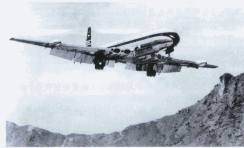
During the 1960s, a huge variety of jets operated through Kai Tak. While the tremendously successful Boeing 707, in its different versions, was the most numerous, the Douglas DC-8, Convair 880, Sud Aviation Caravelle, Comet, VC-10, Trident and BAC 111, and later the Boeing 727 and 737 all made their appearance as the speed, range and economic efficiency of jet aircraft made possible a huge expansion in the travel market.
Within a very short period the jet airliner became the most common means of air travel for millions of people. The old propliners and even the interim turboprops were usually relegated to second line duties or even abandoned altogether. The jet age had truly arrived and the stage was set for the next phase of development - the jumbo and supersonic jet technology which was beginning to appear in the 1970s.
10. Air Cargo
International air cargo operations in and out of Hong Kong, commenced in a small way shortly after the end of World War II, and have grown at an amazing rate.
Initially, air cargo had to share space, and more importantly, weight on aircraft with the main payload of passengers and their luggage. Later, with the development of larger jet aircraft, some companies began to specialise in cargo only flights, and soon most of the major international airlines introduced dedicated cargo aircraft into their flight schedules. The air cargo business had really taken off!
The following statistics underline the rapid growth and development of air cargo handled in Hong Kong since 1947:
|
Year |
Air Cargo (in tonnes) |
|
1947 |
900 |
|
1976 |
176,000 |
|
1981 |
306,000 |
|
1990 |
767,000 |
|
1995 |
1,450,000 |
The ability to handle this increasing volume of cargo is directly dependent on the development of air cargo terminal facilities at Kai Tak. The Hong Kong Air Cargo Terminals Limited (HACTL) opened its Terminal 1, in 1976, and Terminal 2, in 1991. These facilities now have the capability of handling a total of 1,800,000 tonnes of air cargo each year, and will serve Hong Kong well until the shift of operations to Chek Lap Kok in 1998. HACTL is currently making preparation for the construction of a larger Chek Lap Kok facility that will provide an initial throughput of up to 2,000,000 tonnes of air cargo annually.
The air cargo industry has shown a most impressive capability to expand in Hong Kong, and the variety of cargo is remarkable. It may be a charter flight of racehorses from Australia for the Jockey Club, a load of toys and clothing destined for the Christmas market in Europe, or a consignment of fresh fruit and vegetables from the United States. All these movements are handled quickly and efficiently, and help to ensure that Hong Kong maintains its place as one of the leaders in the volume of air cargo handled by any of the world's airports.
11. Modern Commercial Aircraft – 1970 to 1995
On 11 April 1970, the first scheduled Boeing 747 service, operated by Pan American World Airways, arrived at Kai Tak. The era of the wide bodied jet had arrived. The 747 in its many variants has since then been a most frequent visitor to Hong Kong, but has been followed by many other large jets such as the McDonnell-Douglas DC-10, Lockheed TriStar, Airbus and, most recently, by its Boeing stable-mates the 757 and 767.
The wide bodied jets not only carry large numbers of passengers – the latest variants of the 747 are capable of carrying over 400 people at a time into Kai Tak, compared with the single passenger on the De Havilland Express that made the first scheduled flight into Hong Kong in 1936 – but have ever increasing range. Flights can now be made non-stop to Europe and the West Coast of the United States in a matter of hours, compared with the five days and frequent stops of the flying boats.
An occasional, very distinctive visitor has been the Concorde, an aircraft of radically different design philosophy to the wide bodied jets. It has been optimised for supersonic speed, but to achieve this it has sacrificed carrying capacity and range. Although it has never operated scheduled services to Kai Tak, future supersonic designs now on the drawing boards may regularly visit Chek Lap Kok in the twenty-first century.
12. The RHKAAF and the GFS
Before its transformation into the Government Flying Service on 1 May 1993, the Royal Hong Kong Auxiliary Air Force gave 44 years of distinguished service to the community of Hong Kong. Its activities, continued by the Government Flying Service today, range from providing flying doctor services and casualty evacuations, search and rescue flights, police support and VIP flying to aerial survey work and anti-smuggling patrols.
Formed in 1949 as the Hong Kong Auxiliary Air Force, one of the parts of the Hong Kong Defence Force, it was equipped initially with four Harvard IIB and four Auster AOP6 aircraft. In 1951 it added the prefix 'Royal' to its title and four Mk. XXIV Spitfires to its establishment. By 1958, the unit had acquired its first helicopter, a Westland Widgeon. This was followed in the mid 60's by three Alouette Mk. III helicopters, and in 1980 by three Aerospatiale Dauphins. Reflecting a greatly increased role in search and rescue and police support operations in recent years, since 1990 the unit's helicopter fleet has been modernised and increased to eight Sikorsky S-76 and two Sikorsky S-70 Black Hawks.
The RHKAAF have also flown a variety of fixed wing aircraft since the Spitfires were taken out of service in 1955. Most have been training aircraft like the Bristol Bulldog and Slingsby Firefly, but there have been twin engined aircraft as well, such as the Cessna Titan and Beechcraft Super King Air. The longest serving aeroplane in the unit was a Britten-Norman Islander bought in 1972 for aerial survey work. This aeroplane crashed on a training flight in December 1992 in Tolo Harbour, but on the suggestion of the Hong Kong Historical Aircraft Association, the aircraft is being repaired by HAECO so that it can be used for static display in the aviation museum that we hope to see built in Hong Kong.
13. Hong Kong as an Aviation Hub
Each year, the Hong Kong International Airport at Kai Tak handles well over 24 million passengers, that is an average of nearly 66,000 people every day. Many of these are tourists and other visitors coming to Hong Kong to do business, attend conferences or participate in cultural activities. They thus make a major contribution to Hong Kong's economy through the money they spend on shopping, entertainment, hotels and the like.
In terms of passengers handled, Hong Kong now occupies a third rank to Heathrow (London) and Frankfurt airports, thus reflecting its strategic "hub" location in a fast-developing region. In terms of cargo handled, Hong Kong is second to Narita, Japan having handled 1.2 million metric tonnes of freight in 1994.
The central regional location of Hong Kong is highlighted by the fact that virtually every country and major city in Pacific Asia is within six hours flying time from the territory. That area has a population of nearly two billion people, representing about 40% of the world's population. And, even within two hours flying time from Hong Kong is a vast region with a population of 509 million.
Not only is China undergoing rapid economic change but so also are such countries as Vietnam, Thailand, Malaysia and Indonesia. And, on top of that, are the already well-established "tigers" of Japan, Taiwan and South Korea. All this adds up to the fact that the centre of gravity of the world's economy has shifted to the "Asian Crescent" to newly-industrialising countries where there is relatively cheap land, cheap labour, a willingness to adapt to the use of new technology and a strong work ethic. That, in turn, inevitably means that there will be a greater propensity for people to travel through the region for both business and pleasure. And, a key hub, is Hong Kong, the status of which as a centre for regional and international aviation is an undeniable fact.
14. Airport Operations
The passenger arriving at or departing from a modern airport encounters a large number of people involved in different aspects of airport operations. For the departing passenger these may include porters waiting to help with the luggage; airline and security staff at the check-in counters; sales staff in the shops and waiters and waitresses in the restaurants; immigration officers processing travel documents; more security staff to check hand luggage and personal effects before entering the departure lounge, and more airline staff to check boarding passes before the passenger can get to his or her seat on the aircraft. If there is time before boarding, the departing passenger can visit the duty-free shops. An arriving passenger cannot visit a duty free shop but makes up for this by receiving attention from customs officers. Both may see patrolling police officers, be guided by announcers, and make use of the taxis, hire cars or special busses that serve the airport.
This wide variety of services and people seen by the passenger represents only a small fraction of the activities and staff needed to operate an efficient airport. Far more goes on behind the scenes.
Air traffic controllers guide the planes into and out of the airport and its airspace. Ground handling staff look after servicing and fuelling of the aircraft at their stands while maintenance crews check and overhaul them. Cleaning staff prepare the cabins for their next load of passengers and caterers prepare and load the meals. Baggage handlers make sure that luggage travels with the passenger and meets up with them again at their destination. Emergency services are in constant readiness. Inspectors and regulators check to ensure proper use and maintenance of aircraft and investigate any incidents or accidents. Airport business managers negotiate with airlines, franchise holders and service providers to achieve commercial efficiency. And constantly, engineers, designers, and planners are looking ahead to make additions or improvements to equipment, to buildings and to the airport as a whole so as to meet new demands as more people travel, more cargo is carried, and more and newer aeroplanes are delivered.
15. Kai Tak
In 1924, local businessmen Ho Kai and Au Tak started to reclaim land in Kowloon Bay for a speculative housing development. The reclamation was completed, but the venture failed. The land reverted to the Hong Kong Government just at the time when thought was being given to an aircraft landing field and flying boat moorage. On Lunar New Year's Day, 1925 the first aircraft was to take off from the grass strip. The civil airport at Kai Tak was a reality. By 1927 an RAF detachment was housed there in matshed hangers. In 1928 a crane and slipway to handle flying boats were built, and in 1930 the first civilian airport superintendent, Mr. A. J. R. Moss was appointed.
In 1935, the first control tower and fire engine were in place. The first commercial passenger, Mr. Ong Eee-lim, arrived on 24 March 1936 on a mail flight from Penang in a De Havilland D.H. 86 Express Airliner and in 1937 the airport handled all of 3,685 passengers.
The first tarmac runway, 457 metres long, running east-west, was completed in 1939. During the Japanese occupation, a north-south runway 1,371 metres long was added and the earlier runway extended to the same length.
Commercial flights to Kai Tak resumed in September 1945. Within a few years it was clear that major expansion of the airport was needed. In 1954, work began on a new terminal, while in 1956 a contract was let to reclaim 60 hectares of land in the bay to build a new 2,194 metre long north-south runway. By 1965, Kai Tak was handling nearly one million passengers a year.
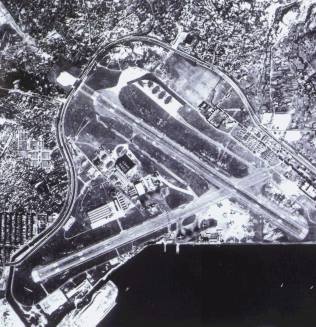
In 1970 the new runway was extended to 2,541 metres, and later in 1975 to 3,358 metres, so as to handle the new large jets like the Boeing 747 and McDonnell-Douglas DC-10. The aircraft parking area was extended as well from a capacity of ten planes to thirty-three. In 1976 over four million passengers passed through the airport and the first air-cargo terminal opened. During its 60th anniversary year in 1987, Kai Tak handled over ten million passengers and half a million tons of cargo. In 1995 this had grown to over twenty-four million passengers and nearly one and a half million tons of cargo.
16. Chek Lap Kok
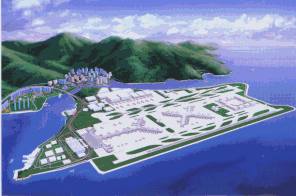
One of the world most passenger-friendly airports was opened at Chek Lap Kok in 6 July 1998, with the terminal building rising above the foundations and work taking place all over the 1,248-hectare island - roughly the same size as the Kowloon peninsula. Forming the airport site was a massive undertaking, involving the excavation of the islands of Chek Lap Kok and Lam Chau and a huge marine reclamation operation. At the peak of activity, 250 tonnes of material was being moved every minute of the day. The airport will have 24-hour operational capability, one runway, a large, efficient passenger terminal and many other essential facilities. On opening, the airport will be able to deal with 35 million passengers and about three million tones of cargo a year. Flexibility of design allows for easy, cost-efficient expansion in the future. The highest environmental standards have been a key element of the Provisional Airport Authority design and construction work.
Travelling to and from the airport will be quick and easy, with fast road and rail links now taking shape under the government�s Airport Core Programme. The journey time from downtown Hong Kong will be about 23 minutes by rail and about half an hour by road.
Passengers who arrive at Chek Lap Kok in 1998 will discover a fitting gateway to Hong Kong and South China, which will be at the hub of economic development in the twenty-first century. The past, however, will not be forgotten. The Provisional Airport Authority has offered to provide a place of honour to display the replica of Hong Kong's first aircraft, the Farman II biplane. The contrast between the frail structure of the Henry Farman and the new generations of high speed, high capacity aircraft that the new airport is designed to handle will provide a vivid demonstration of technological development in the twentieth century. The replica will serve as a reminder to all people of the long and fascinating history behind Hong Kong's modern facade.
Kai Tak will cease to be an airport once Chek Lap Kok is opened. The site will be developed as part of the Metroplan design for transforming the old urban area of Kowloon into a modern city area. But new development need not obliterate the past. Many of the buildings at Kai Tak are of historic importance and have much economic life left in them. The Hong Kong Historical Aircraft Association is supporting an idea that a group of these buildings be refurbished as an aviation museum and aviation academy. This would serve as a research and education centre, a reminder of Hong Kong's aviation history and technological development, and as the training ground for the next generation of Hong Kong's aviation leaders.
17. Future Flight
We live in a fast changing world where new technological developments quickly lead to even better ideas and products. Nowhere is this more true than in the world of aviation.
Just over 100 years ago the idea of flying was a fantastic notion to the average person in Hong Kong yet today we travel at 39,000 feet, at over 500 miles per hour without a second thought!
What can we expect in the next 100 years – or even the next 50 years in the field of aviation? Rest assured that there are still visionaries and dreamers in the world and that the developments we will see will be simply astounding!
Hong Kong is on the threshold of a new era of aviation that will be made possible by the opening of the new airport at Chek Lap Kok in 1998. It is being designed in all respects to incorporate the latest, proven technology and still leave scope for future innovations. It will become a hub airport probably second to none in Asia serving a rapidly developing region where the collective spirit and legacy of the early pioneers of aviation remains an inspiration for contemporary men an women of vision.
To those who dream . . . and see the future in the skies!